If you didn’t know, since 1949, May has been Mental Health Awareness Month in the United States. This year, the National Alliance on Mental Illness (NAMI) is encouraging Americans to “Take the Moment” to share stories and resources, “fostering open dialogues, cultivating empathy and understanding.”
According to Statista, 50+ million Americans have consulted a therapist within the past year. This past month, I joined their company, and I’ve committed to regularly dedicating time and bandwidth to healing and mental health. Admittedly, it hasn’t been an easy process for me, and each week a part of me wants to stop going, but I’ve been thankful for the motivation and accountability to keep pushing forward.
Last week, on the second day of May, while sitting in what I kept telling myself “I’m not going to call my last session,” my therapist and I started talking about a burden I’ve been carrying since middle school. I’d previously mentioned that I’d never shared this burden with another Christian, though I recalled a moment standing with my dad in a supermarket years ago, wanting to say something and to cry out for help, but only summoning the courage to hint at it indirectly.
“Come to think of it,” I volunteered, “I’m not actually sure why I never told him. I guess I felt too much shame, and it just didn’t feel like something a parent and kid could talk about…” I paused for a moment and then continued, “From everything I know about my dad, I think I could’ve told him. He would’ve been fine.”
I left the office shortly after and drove over to Greenfield Village, where Dad was waiting for me. He hadn’t visited Henry Ford’s outdoor museum since we’d gone together when I was a kid, and it was a sentimentally special place to both of us. We walked around for a while, and then I asked him, “Hey, can I lay something pretty heavy on you?”
“Yeah, what’s on your mind?”
“I don’t know why I didn’t tell you this sooner. I think I just felt guilty and ashamed, and it’s an uncomfortable thing to talk about, but I’ve kinda come to the place with this thing that I just don’t feel like I have anything to lose anymore.” And I told him.
“I can’t tell you how many people I’m praying with about stuff like this” he said, with empathy. “It’s not OK,” he told me as he hugged me, “but it’s OK.”
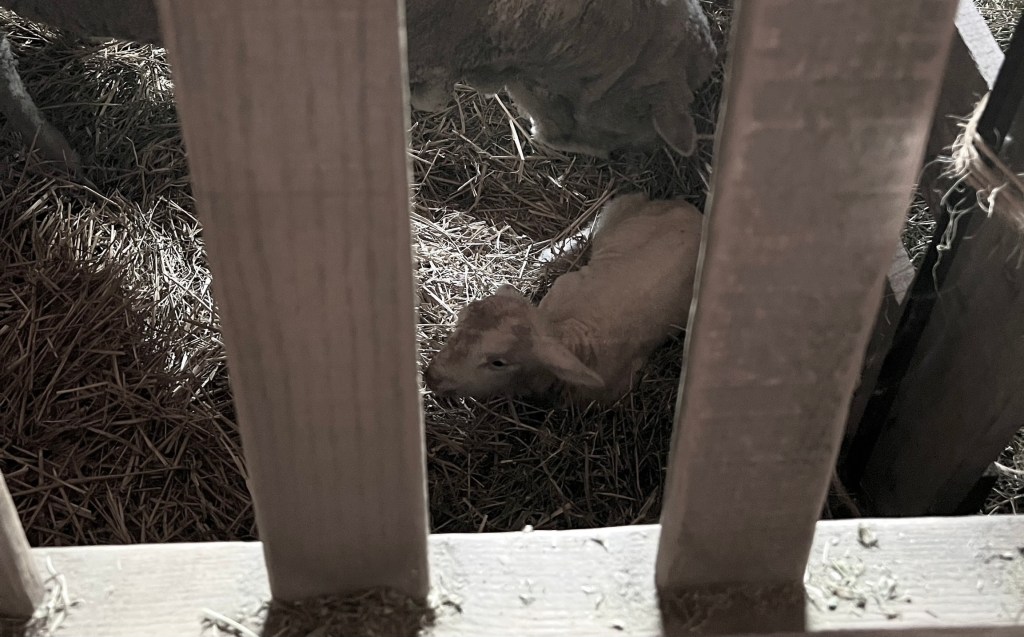
We kept walking. Dad wanted to walk through the little farm at the village. We went through a barn, and he pointed out equipment and parts of the barn’s structure that were similar to the barn we’d both grown up in. Then we wandered into the stable, with mostly goats and sheep inside. An employee and a visiting family were at the far end of the stable, gathered around a wooden fence. One visitor walking past us to exit the stable said, “There’s a little lamb down there, just born an hour ago!”
We walked over, and sure enough: There was a baby lamb, looking like a kitten curled up in the hay (pictured above). I’d never seen a lamb that small, and I couldn’t take my eyes off it.
The moment immediately felt like a gift to me personally. This lamb had been born as Dad and I were walking the grounds—as I’d named one of my life’s biggest struggles aloud and immediately been embraced. The words of John the Baptist echoed in my mind: “Behold, the Lamb of God, who takes away the sin of the world!” (John 1:29)
These steps forward have come in no small part, I’m sure, thanks to the countless hours lately spent immersed in Psalms. For the past couple weeks, I’ve been listening through Ps. 73-89, which make up Book 3 of Psalms. This book contains a surprising number of laments, I’ve found. These are psalms Walter Brueggeman calls “psalms of disorientation” (as opposed to psalms of orientation or reorientation).
In psalms of lament, an individual or community expresses emotions like anger, confusion, and frustration. These are the times we feel like we’re in Sheol, “the pit,” and we feel like God has abandoned us, or forgotten about us, or stopped loving us, or when we don’t understand why God won’t step in and act now.
To continue with the theme of Mental Health Awareness month, I hope to spend the next couple weeks unpacking some of the deep emotions in these psalms, including my own prayers modeled after them. With that said,
Up Next: Psalm 77
Psalms, Book 3 Playlist: Here, on Spotify
Resources:
- Capps, Kory. “Rhythm Of Life: Orientation, Disorientation, Reorientation.” From the Fray. N.d. https://www.fromthefray.com/rhythm-of-life-orientation-disorientation-reorientation/
- MacDonald, John B. “The Blessing of Lament: A Disorientated Soul’s Yearning for God.” Living Theology. 21 April 2023. https://www.johnbmacdonald.com/blog/the-blessings-of-lament
- NAMI.“Mental Health Awareness Month.” National Alliance on Mental Illness. 2024. https://www.nami.org/get-involved/awareness-events/mental-health-awareness-month/


 Detroit, Reformed.
Leave a reply to Anonymous Cancel reply