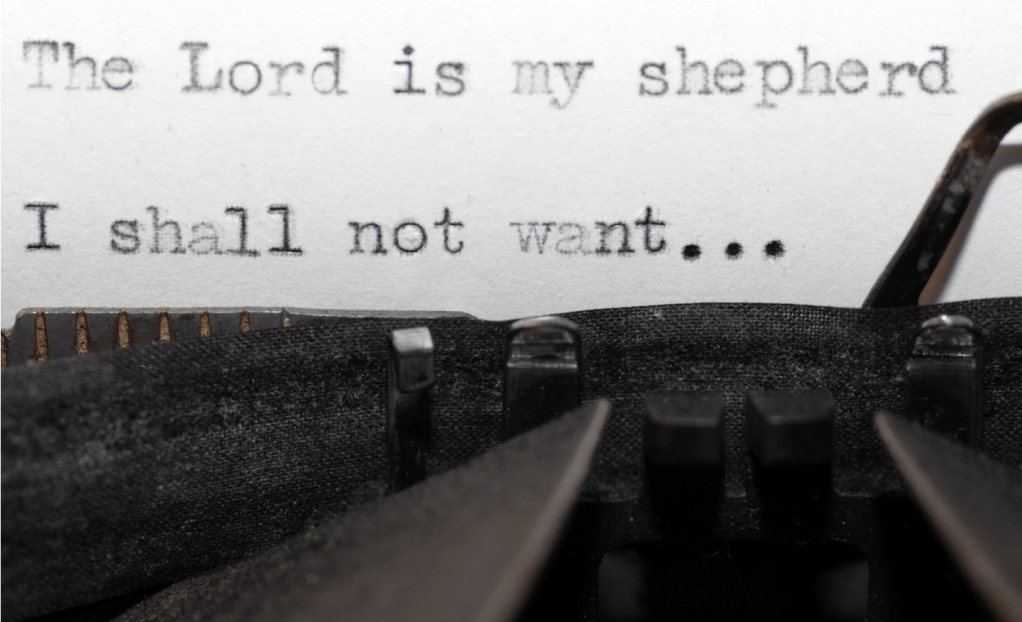
Growing up, one of the things I heard most often about my Oma was that she really knew the psalter. She grew up singing the psalms in church (as many of my Dutch relatives still do today), and she prayed them for herself and her loved ones regularly. My dad frequently voiced his admiration of that, lamenting that he didn’t know them as well as he’d like.
I’ve long heard, from more voices than just my father’s, that knowing the psalms well is immeasurably valuable:
The German Reformer, Martin Luther, once said of the Book of Psalms, “Everyone, in whatever situation he may be, finds in that situation Psalms and words that fit his case, that suit him as if they were put there just for his sake, so that he could not put it better himself, or find or wish for anything better.”
John Calvin (need I say, “the French Reformer”?) agrees, “Not without good grounds am I wont to call this book an anatomy of all parts of the soul, since no one can experience emotions whose portrait he could not behold reflected in its mirror. Yes, the Holy Spirit has there depicted in the most vivid manner every species of pain, affliction, fear, doubt, hope, care, anxiety, and turbulent emotion, through which the hearts of men are chased.”
In fact, Melanchthon, another German Reformer, called Psalms “the most elegant work extant in the world.” So clear was that to everyone in the early Church that John Chrysostom, the fourth-century “golden-mouthed preacher” of Constantinople, could say with confidence, “All Christians employ themselves in David’s Psalms more frequently than in any other part of the Old or New Testament. The grace of the Holy Ghost hath so ordered it that they should be recited and sung every night and day.”
I’ve realized, to my shame, that the same cannot be said of me: I don’t spend more time in the Psalms than in any other part of the Old or New Testament. I haven’t been reciting or singing them every day and night. But, I thought, wouldn’t it be great if I could?
I memorize Scripture best when it’s set to music, and the psalms were (for the most part) written to be music, so what’s stopping me from knowing them better?
With that in mind, I decided to take action: I’ve started curating playlists on Spotify with all the psalms, in order. Often, I found a song that included every word of the psalm at hand, and that was sufficient. Other times, a good song sung only a portion of the psalm. In those cases, I included a reading of the entire psalm before or after the song, so I’d still hear the full text.
Still other times, the version I love most is in Hebrew. Those are psalms I’ve been able to take the time to go through in depth, and they ring in beauty and fullness in Hebrew. Lord willing, one day I’ll know all the psalms well enough to make an entirely Hebrew playlist. For now, I include some of my favorites in this playlist. For the benefit of others, I’ve found and included an English version to complement it.
So far, I’ve put together Book 1, which includes Ps. 1-41. Here is the playlist:
There are a few here that I’m not entirely satisfied with, but I’m hopeful that it’s a great start. (If you have any psalm songs you like, send them my way!)
I’ve been listening to this playlist on repeat for the past week, and it’s done a lot to foster in me moment-to-moment contentment. If anyone else is blessed by this, too, praise the LORD.
Up Next: Next week, I’ll be teaching as a guest in our Tuesday morning Community Bible Class. They’ve been going through Deuteronomy this semester, and I’ll be covering Deuteronomy 24:1-26:19 with them, with a lesson on “Human Rights and Privileges.” Lord willing, I’ll post the teaching video and notes here.
Sources:
- “The Glory and Sufficiency of the Psalms.” Covenant Protestant Reformed Church. 2024. Web. https://cprc.co.uk/quotes/glorysufficiencypsalms/#:~:text=(1)%20“I%20believe%20that,they%20were%20written%20for%20him.”


 Detroit, Reformed.
Leave a reply to Anonymous Cancel reply