This past weekend, I had the privilege of serving as the Lay Director for Fort Myers Great Banquet #40. Named after one of Jesus’ teaching illustrations, recorded in Luke 14:15-24, the Great Banquet “is an orderly, structured weekend designed to strengthen and renew the faith of Christians.” Guests spend 72 hours experiencing authentic community and unconditional love, and many (myself included) find it to be a powerful, transformative space.
I’ve been around the Great Banquet since I was a kid, as my parents have both been serving on teams for over 20 years now. I went through as a guest back in 2016, the summer before I moved to Japan. I immediately knew I wanted to be a part of future teams (I even flew back from Japan just to attend a weekend once!), and it’s been one of my life’s greatest blessings to serve alongside family members in this ministry.
One of the “orderly, structured” parts of the Great Banquet is its 15 talks–five messages each day, delivered by team members prayerfully selected by the Head Spiritual Director and the Lay Director. As the Lay Director for this particular weekend, my task was to deliver a talk entitled, “Staying Power.” The goal of this talk is to encourage guests (and team members!) to get into small groups, to continue experiencing the Christian community, study and prayer they experience at the Banquet.
How perfect, that I of all people would be assigned to talk about small groups! As we’re in the midst of discussing my church’s current small group series, I thought I’d share some of “Staying Power” with you now. So, without further ado…
When I was a junior in high school, I started taking classes at a local community college. I got all the basic requirements out of the way–the ones all students for all majors have to take: I took Chemistry and Biology, Art History, Sociology and Psychology, Economics…I also took the first intro courses to my English major: English Composition I and II, Intro to American Literature–all that stuff.
I loved those community classes. A big part of that was the fact that the class sizes were so small. The biggest class I had was, maybe 30 people? That meant I could get to know people in the class, but even more importantly, it meant I could get to know the professor–and the professor could get to know me. I never hesitated to ask questions in class, because the professor had time. The professor knew my name, knew my strengths and what I was working on.
I took enough classes there that I completed a two-year Associate’s degree at the same time I finished my high school diploma.
When I graduated, I transferred up to Florida State University in Tallahassee. I went to orientation and moved into a dorm hall together with all the other first-year students who were starting as true freshman, while I would technically be an upperclassman.
From my first semester at FSU, I was taking the courses I really wanted to be taking: I got to do things like sit in a room with 15 other people who loved Shakespeare and dissect Shakespeare plays for a whole semester. I could sit with a dozen other students and really drill in my Russian language classes. (Doesn’t that sound like fun? No? Hello?)
About halfway through the semester, after midterms, I noticed something. There were quite a few students who weren’t enjoying the semester as much as I was. In fact, some of them were really struggling. They were sitting in big lecture halls, taking Chemistry or Economics or Psychology in a room of well over a hundred people. Those spaces felt impersonal to them. They were lost in a big sea of students, and they found themselves wondering if their major wasn’t cut out for them after all.
“No,” I thought. Your major isn’t the problem. The problem is you’re in a huge classroom where no one knows you, and you don’t feel like your professor has time to answer your questions in class, and you’re only going over the surface stuff, the introduction classes. Just wait. Persist. Persevere. When you get to the classes in your major, where everyone in the room is really invested in that content with you, you’ll feel a lot better and you’ll grow a lot more.
What you need, is staying power.
In Matthew 22, Jesus said, “‘You shall love the Lord your God with all your heart, and with all your soul, and with all your mind.’ This is the greatest and first commandment. And the second is like it: ‘You shall love your neighbor as yourself.’”
This is a summary of the entire Bible: What is our personal relationship to God, and what is our relationship to others? Our lives are spent striving to love wholly on both of these fronts. Many of the talks at the Great Banquet focus on exactly this: How do we love God with our mind, our strength, our heart and soul?
Three talks focus on loving God with our minds:
In “Discovering Priorities,” we’re asked to sit down and evaluate what’s really got a grip on our minds, and we’re encouraged to make intentional efforts to align our priorities so that we live as the people God made us to be.
“The Truth through Study” encourages us to be in the Word. That’s where that “greatest commandment” can be found, after all! God hasn’t left us in the dark about His will for our lives. So, learn it. And know this: Truly learning happens best in small groups, not in big lecture halls, not even in big sanctuaries. You’ll benefit so much more from being in study on your own, and then taking it to a group of people who can be a sounding board for your ideas and questions. (Different perspectives help us see the truth more completely, and also keep us from wandering into our own interpretations unchecked.)
Then, with “Changing Your Environment,” we see that when you’ve established God-centered priorities, and you’re in the Word on your own and with other Christians, you’ll notice your perspective changed. As you go through the world in your different environments, you’ll be grounded, centered in Christ, more equipped to engage your mind to be salt and light to those you encounter.
Three talks have focused on loving God with our strength:
“The Ministry of All Believers” and “The Life of Christian Action” exhort each of us to do all in our power to meet people and walk with them one step closer to Jesus, and “The Body of Christ” reminds us that we don’t make that effort alone: We’re all given different abilities and perspectives and visions so that we’re stronger together than we are as individuals.
Finally, three talks focus on loving God with our hearts and souls:
These talks focus on the willful actions we take to give our lives more and more to God. “The Way of Relationship” asks, Have you actually surrendered your heart to God? Or does it belong primarily to something or someone else, maybe even yourself? There is a willful action on our parts to prioritize a relationship with Jesus. Realizing this is the first step that gets you started.
Then, through “Disciples,” we appreciate that learning Jesus and becoming more like Him is a life-long process. It’s a process that takes dedication. It’s repeated, willful walking in Jesus’ footsteps. This is the second step that helps you grow as you walk.
Finally, the third talk that focuses on our wills is this one: “Staying Power.” This is how you grow from the initial moment of choosing to surrender, to faithfully walking as a disciple. To put it in the hiking lingo I love: How do you keep walking? How do you resist quitting and getting off trail? How do you find the will to go on?
As with everything in our Christian walk, let’s look to Jesus as our example.
After being tempted in the wilderness for 40 days, Jesus goes back to Galilee and calls disciples. He goes up to them and makes an individual call on each of their lives: “Follow me.” Then what did he do? He called another one, and another one, until he had a small group: 12 core disciples who would do life with Jesus.
Jesus grew really close to this small group. He talked about God’s Word with this group. He ate with them. Went to wedding parties with them. Celebrated holidays with them. Traveled with them, taught them, prayed with them. These 12 men grew from disciples who were called in by Jesus into Apostles who were sent out by Jesus. This happened by living life and learning Jesus in a close-knit group.
This is the pattern Jesus has set for us: Discipleship, spiritual growth and maturity, happen in small groups.
The author of Hebrews encourages his readers “not to forsake the assembly of the saints as some do” (Hebrews 10:25). Some people think they can get by spiritually on their own, because they’re smart enough. They’re grounded and reasonable enough to handle it alone. “We’re called to go out and minister in the world,” they might rationalize, “so we may as well go all in and just be in the world!” That’s pride talking.
God told us, “It’s not good that man should be alone” (Genesis 2:18). God told us, “Where two or more are gathered in my Name, there I will be also” (Matthew 18:20).
And we have our own expressions that attest to this, too, right? We say, “Iron sharpens iron.” We say, “Surround yourself with who you want to be.”
There’s a lot of good sense behind each of these expressions. But the long and the short of it is this: Jesus prioritized living life in a close-knit group of Christians, and each of us should do the same.
Priorities are a matter of choice. This is going to take willful action. It’s going to take commitment from the heart. It’s going to take persistence to move steadily forward in the direction God is leading, and it’s going to take perseveranceto keep persisting when it gets hard to go on.
It means following God even on days when you aren’t really feeling it. The heart is deceitful above all things, and desperately wicked, Jeremiah 17:9 tells us. We can’t always rely on our hearts in a given moment to lead us to what’s truly best for us. Sometimes choosing God’s way is going to contradict our feelings in the moment. Sometimes it’s not going to seem like the logical choice in the moment. Sometimes it’s going to feel like God’s asking a whole lot.
So, to have staying power, you need discipline. Disciples are disciplined. It takes forming new habits, so that on days you don’t have enough will power to act, the force of habit can carry you along. Forming habits when you’re strong gives you staying power when you’re weak. Store God’s Word in your heart, and develop relationships with other Christians. These are investments in your spiritual future! This is planting seeds that will grow into trees that blossom and bear fruit.
The principle of habit we’re focusing on now is staying connected.
Every Christian needs to stay connected in two ways:
(1) Stay connected to Christ, and
(2) Stay connected to other Christians.
First, stay connected to Christ.
Jesus is the means by which we grow in the life of God. He said to his disciples, and so to us, “I am the vine; you are the branches. If a man remains in me and I in him, he will bear much fruit; apart from me you can do nothing” (John 15:5).
Maintain contact with Jesus through prayer, study, and worship. It will renew and strengthen your relationship with Him.
Second, stay connected to other Christians.
Prayer, study, and worship happen on your own, and they happen with groups, with the Body gathered together. Other Christians are the main way we receive encouragement to continue walking with God. That Hebrews verse I quoted earlier starts off, “Let us consider how we may spur one another on toward love and good deeds.” Well, let us consider it! How do we spur one another on toward love and good deeds? The author continues, “Let us not give up meeting together, as some are in the habit of doing, but let us encourage one another…” (Hebrews 10:24-25). This is about habit! We need to be in the habit of connecting with other Christians.
Contact with other Christians who share our priorities–who have the same major in the school of Christ, if you will–provides ongoing support and inspiration. This is one of the means God has chosen to use to work in us and through us.
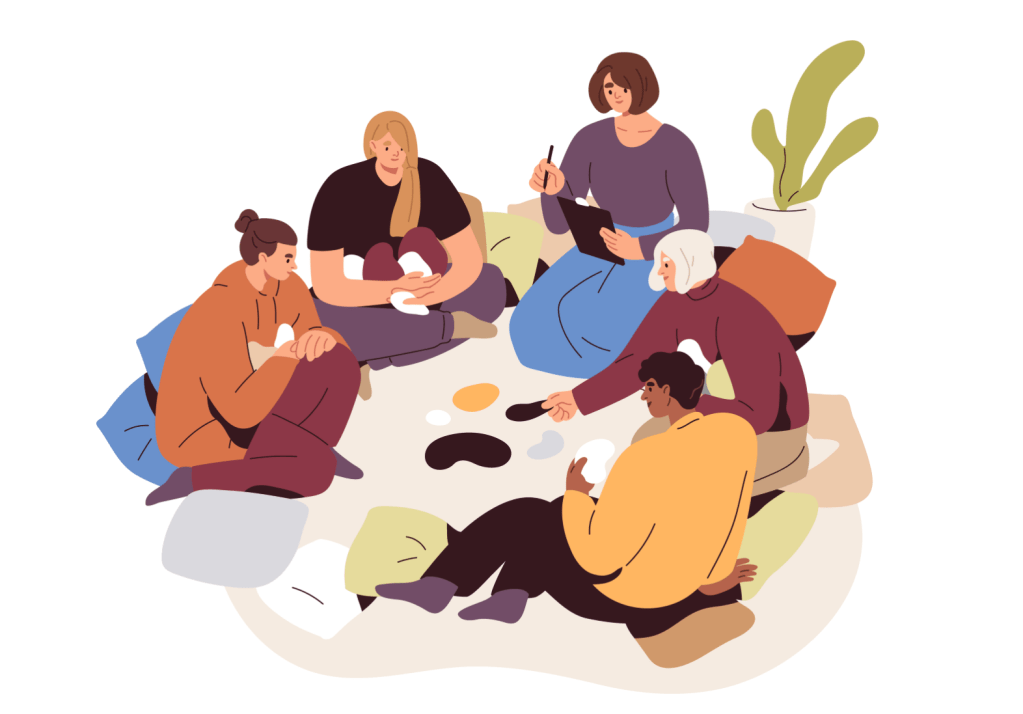
If you’re not already connected to a small group of Christians, I whole-heartedly encourage you to seek one out. Many local churches have a small group ministry in place. At my church up in Metro Detroit, I send weekly sermon-based discussion questions out, and lots of groups meet to dive deeper into what they heard in the message on Sunday. Other groups choose a book of the Bible and work through it together. Others find a series that is on the group members’ hearts, like one about healthy marriages or on spiritual gifts, and they go through that together for a season.
If your church doesn’t have small groups but God puts it on your heart to be involved in a group, don’t shy away from the possibility that God might be calling you to be the one to gather people together and get the momentum going. That’s what happened to little introverted me! My church in Osaka, Japan, didn’t have an established small groups ministry, but I was so ready to talk about the Old Testament with people that a group of girls said they wanted to study the Bible with me, and that’s exactly what we did. We started meeting in one person’s home, and we studied the Bible together, and we’re still going! What’s more, those ladies have steps up into leading for themselves. They’ve grown into disciples. That happened organically, in a small group, because God put it on someone’s heart to form the kind of group Scripture models for us.
I’d encourage you today to be in prayer about the opportunities God might have for you to start or to grow a small group of Christians to focus on knowing Jesus and making Him known. Together, you can be united in study and in service, in worship and in prayer.
I’ve said it before: Small groups are a lot like an immediate family. These are your brothers and sisters, in Christ. These are people you can let your spiritual guard down around. There’s something special that unites you. It’s so important to have a space where you can breathe and be yourself. Let people know the stuff you’re struggling with in your heart, and join with them in prayer. Jesus said in Matthew 18:19, “I tell you that if two of you on earth agree about something and pray for it, it will be done for you by my Father in heaven.” There’s a promise of power here.
Your God has promised to show up and work both in small groups and through small groups of Christian believers. So today, I leave you with the challenge to show up and work in a small group, too. Show up, and do everything in your power, through Christ, to stay.
If you’re following along with our small group series on the Apostles’ Creed, you can access the workbook material for Session 4 here.
The accompanying teaching video is here:

 Detroit, Reformed.
Leave a comment